Saturday, September 29, 2018

AMERICA, WE HAD A GOOD RUN Part II


Increasingly, America is ruled by two tribes of lunatics, snapping their fingers, ready to break into a dance fight at any moment. While Trump has indeed cranked it to 11, he is but the cherry on top of the banana split. How did we go so wrong?


West Side Story


American education was once the best in the world but as early as 1948, Richard Weaver wrote “…we have lost our grasp of the nature of knowledge...” Schools have become “social centers…where teachers, living in fear of constituents, dare not enforce scholarship, and endeavor to turn classes into democratic forums…” And, while knowledge alone will not make citizens more moral or kind or refined, a nation cannot be great without great schools. The 2015 ranking from the Organization for Economic Co-operation and Development, which includes countries like Tunisia and Kazakhstan, puts the U.S. at #39 in math, 24 in reading, and 25 in science.


One problem is the deep resistance to reform embedded in teachers’ unions. Unions tell us that teachers are the bedrock of society. But if that’s true, wouldn’t it be important to have good teachers? And to have good teachers, shouldn’t we be able to fire bad ones? In California, where fruit and common sense are stopped at the border, one teacher fed semen-laced cookies to his students. Several victims now have eating disorders but the district had to pay him $40,000 to quit due to the arcane steps required to fire someone. In 2014, a California judge ruled the state’s lax teacher tenure violated students’ civil rights. He was overturned.


Yet, dangerous as general mediocrity is, perhaps the bigger danger to the republic is the pervasive indoctrination that saturates everything from English to Home Economics. “Ohhh, Omnipotentblog. Isn’t that just another whiny conservative trope disproved by this Huffpo piece I read the other day?” asked a friend, a professor at an elite university while sipping cherry Kool-Aid. (True story.) Well, the liberal Atlantic disagrees. In “Admit It, American Colleges Do Indoctrinate Students”, Conor Friedersdorf argues that it does happen but it’s generally a good thing.


Gresham’s law in education states that content that leads to credentials more easily will replace that which is more difficult but has higher intrinsic value. With the advent of Gender, Ethnic and other grievance-oriented programs as well as the infiltration of those values in most other subjects, the bad replaces the good. This material naturally displaces traditional education not only because it is favored by instructors but because time and resources are limited. And when you have a society to indoctrinate, American History and Shakespeare must go.


If you approach two random professors sipping lattes while complaining about the Nixonian conservatism of that imperialist dog Leon Trotsky, they would likely have difficulty naming a Republican colleague. According to one recent study, the ratio of liberal to conservative professors is almost 12 to 1. Economics, the most conservative profession is a mere 4.5 to 1 but in history, the ratio is over 33 to 1. What’s shocking is how these numbers have shifted in the last 50 years. A 1968 study put the ratio in history departments at just 2.7 to 1. As recent as 2004, liberal history professors outnumbered conservatives by as little as 9 to 1. One recent study from Stanford found that conservative-leaning law professors face overt discrimination in promotions and hiring. Another study of social psychology professors noted 37% would not hire a conservative and 44% thought their peers would not. 37% also believed their peers would discriminate on a grant review. My defensive friend points out that STEM professors are generally not communists. While true, STEM students are less than 40% of all graduates, which means the overall ratio for non-STEM fields is far higher than 12 to 1. Primary and secondary education are no better as 85% of elementary and 87% of High School teachers identify as liberal.


Is there evidence students are brainwashed? In a slightly dated study, two researchers found only “slight shifts” in ideology.


But when analyzing the numbers, the “slight shifts” are rather striking. “Far left” students more than doubled while the “far right” cohort dropped nearly a third. Conservatives dropped by 10% while liberals enjoyed a 25% bump. This is hardly insignificant.


How did education drift so far from the broader culture? The social ferment of the 60’s did lasting damage to the nation and education was not spared. In 1969, armed, militant black students, angry over Cornell University’s pervasive “racist attitudes” and “irrelevant curriculum”, seized control of a dormitory. Death threats were phoned to professors who had previously opposed them. Thomas Sowell, a black economist and Cornell professor until 1968, did not experience the alleged mass racism on campus but he did have harsh words for the president at the time, James Perkins, whom he described as “a veritable weathervane, following the shifting cross-current of campus politics…the quintessential appeaser and dispenser of pious rhetoric”. With their demands happily met, the militants walked free.


Another Cornell professor at the time, Allan Bloom, wrote in “The Closing of the American Mind”, that “universities gave way under the pressure of mass movements and did so in large measure because they thought those measures possessed a moral truth...” Perkins “had a mixture of cowardice and moralism not uncommon at the time…(he) thought he was engaged in a great moral work.”


In 2018, on American campuses, leftists now feel empowered to threaten violence, physically assault conservatives and journalists, rip posters out of teenaged hands, shout down speeches, riot, and commit an extraordinary number of other fascist and violent acts. This happens because the ideological progeny of James Perkins support it.


Jonah Goldberg describes the 1930’s as a “fascist moment”. A world-wide depression had shaken confidence that democracy could solve problems and there was great affection, fawning in fact, over movers and shakers like Mussolini and Hitler. WWII changed this, of course, but that doesn’t erase the fact that there was a time when many viewed the Bill of Rights as crusty and stale. Is Western Civilization having another “fascist moment”? The left has made serious attacks on the 1st, 2nd, 4th, and 10th amendments and many on the right embrace a president that, while unfairly slandered as fascist, appears thoroughly annoyed he has any restraints at all.


When an entire generation expresses fondness for socialism but can’t even define it, it’s time to admit our schools have failed. Fixing education would be a daunting task. Perhaps when Millenials start running everything and really making a mess of it, panic will ensue and a correction will begin. When that time comes, God willing, maybe we should start with the teachers and school books first. 

Sunday, August 5, 2018

AMERICA, WE HAD A GOOD RUN


or

WHAT THE BLEEP IS GOING ON? 

Part I


My last unfinished blog asked whether America was in decline. I had data on crime, drugs, mental illness, declining morals and other issues which clearly pointed to an unravelling. And then my laptop was stolen, yanked from my feet at Starbucks. I chased the man but…(sigh)…I’m fat. I lost the computer and the piece. And some sweet headphones. Bastard. Surely the incident was just a coincidence but a year and a half later, it now seems silly to even ask such a question. Of course everything’s going to hell.


Why?


A few years ago I became obsessed with the Enlightenment, Western Civilization and the Reformation. Millennials were rejecting universal dogma about free speech and embracing socialism. SOCIALISM! As grandma would say, “Oh, for cryin’ out loud in a bucket.” I thought if we better understand the cultural blessings we take for granted, maybe we can save them. I was not alone. Pieces on the Enlightenment have become a cottage industry. Famous economist John Maynard Keynes once said, “Ideas rule the world. In fact, little else matters”. Well, for the first time since the industrial revolution, the West is questioning the very ideas to which we owe our existence.


To counter the horrors of the Wars of Religion (1517-ish to 1648) and the centuries-long tension ignited by the Reformation, some felt the answer was to reject objective truth itself. To paraphrase John Lennon, if there’s no belief, there’s nothing to fight over. Hence, we live in a time where cosmopolitan debunkers scoff at notions of Natural Law and timeless truth as crusty and primitive (except for that one truth that says there is no truth, of course). With straight faces, they swear they have no ideologies; They’re just, you know, pragmatic. Two giants of modern Christian thought held this view in utter contempt. C.S. Lewis in “The Abolition of Man”, wrote that a hard heart (believing in nothing) is no defense against a soft mind. He was likely intentionally echoing G.K. Chesterton who said, "When people stop believing in God, they don't believe in nothing—they believe in anything." The future seems to have vindicated them.


We hear from the most obnoxious of atheist evangelists that purging religion will usher in a golden age of reason. David French’s Post Christian America: Gullible, Intolerant and Superstitious disputes this. French recalled how his Harvard classmates sneered at the absurdity of the New Testament but thought reincarnation was “cool”. French lamented seeing Harvard students walk in and out of the witchcraft store and he described one friend talking about her son’s “Indigo Aura”. 


Mother Jones noted a rising belief in astrology.


Not strictly an American phenomenon, Europeans are embracing their own silliness. In the Wall Street Journal, Naomi Schaefer Riley writes that “In Austria, 28% of respondents say they believe in fortune tellers; 32% believe in astrology; and 33% believe in lucky charms…(“They’re after me Lucky Charms!”) More than half of Icelanders believe in huldufolk, hidden people like elves and trolls.” She quotes Baylor scholar Rodney Stark who stated, “More than 20 percent of Swedes believe in reincarnation…half believe in mental telepathy.”


In National Review, author and professor Clay Routledge remarked that decline in religiosity is connected to more belief in ghosts, UFO’s, and clairvoyance and that those who reject traditional belief often embrace what he describes as “supernatural-lite” beliefs, “often wrapped superficially in the language of science and technology, making them more palatable” to the irreligious. He noted, however, that those rejecting theism are often still influenced by it. Finnish researchers found that both theists and atheists exhibited similar levels of physiological stress when reading aloud statements daring God to cause harm.


Routledge wrote that while many are finding nontraditional substitutes for church, “there are reasons to doubt that those are effective substitutes for religion”. He writes that the substitutes are more individualistic and focused on personal interests rather than social duties and interdependence. They are belief systems that lead to loneliness. Routledge called religion a “uniquely powerful” resource for meaning because it “binds individuals to a meaning-sustaining social fabric.”


“Let us not neglect meeting together, as some have made a habit, but let us encourage one another…”

                                                                                                                       Hebrews 10:25


Suicides have risen an alarming 30% since 2000. One author noted that the average anxiety of the incoming freshman was equal to that of the average mental patient in the 1960’s. Parenting expert John Rosemond claims that mental disorders in youth have increased 50-fold since the 1950’s. In a piece on Intellectual Takeout, Marcus Roberts noted how the same Clay Routledge documented this increase in suicide as due in part to a crisis in meaning.  Routledge says there is much empirical evidence for existential anxiety being tied to substance abuse and other mental health issues. Roberts writes, “…the changing landscape in the USA is undermining people’s sense of meaning. The decline of neighborliness, the shrinking of the family and the diminishing of religion are all posing serious threats to a meaning of life. Americans today are less likely to know and interact with their neighbors, they are less likely to believe that people are generally trustworthy and to feel that they have individuals they can confide in.”


Millenials are the least religious generation in history. Is it a surprise they are so lost? British Prime Minister Theresa May called loneliness a national crisis. She appointed a minister to tackle a problem believed to affect over 9 million in her country. I would argue, however, that loneliness is but a symptom. In “Man’s Search for Meaning”, existential psychologist Viktor Frankl described how his fellow concentration camp victims displayed great disparities in reacting to the crisis. Those who rejected nihilism and embraced their God or connectedness and service to others were able to stave off despair. What shocked him was that, in the midst of the depths of some of the most profound human misery—starvation, typhus and imminent execution—some appeared…happy. They knew that whether in life or in death, in abundance or suffering, life had meaning.  Witnessing this changed his life.


I am a deeply religious person. I see religious thought and behavior everywhere because I know what that is. I see non-believers often as no less religious than churchgoers. People need meaning. They need to be part of something bigger than themselves. I think this is what drives many social justice warriors. The big battles against racism were already won but they want to fight the same evil. So they tackle the horrors of offensive Halloween costumes and ethnic food in the cafeteria. Maybe they need some of that old-time religion.

Tuesday, August 16, 2016

HOW RACIST ARE WE REALLY? Part II


Some argue there has been little racial progress since the fifties but even the president says this progress simply cannot be denied. Can anybody see a man named Barack Hussein Obama being elected president in 1960? The idea is laughable. What racial arsonists like Black Lives Matter fail to see is that decades ago, battles were fought over segregation, lynchings, and voter suppression (the real kind). The very existence of words like “micro-aggression” and “cultural appropriation” is proof that times have changed.


Is racism really everywhere? In 1997, CNN and Time conducted a poll that asked white and black teens “Is racism a major problem in America?” Both groups said, "yes." But when black teens were asked if racism in their own lives was a "big problem," a "small problem" or "no a problem at all", 89% percent said racism was a "small problem" or "not a problem at all" for themselves. In fact, not only did black teens see racism as insignificant in their own lives, but nearly twice as many black teens than whites called "failure to take advantage of available opportunities" a big problem in their lives. Could black perception of mass racism really be an illusion?


In gauging the true extent of racism, simply looking at intergroup disparities is not helpful. Thomas Sowell, a conservative black economist, notes that one of the stupidest ideas in all of politics is that all groups in a society should end up with equal results. If one child comes from a family where sports are discussed every night over dinner and another comes from a family where science and literature are discussed, are they really likely to be equally successful? Sowell notes in Wealth, Poverty and Politics that across the world, many ethnic minorities actually excel such as the Chinese in southern Asia, the Lebanese in Ethiopia and the Armenians in Turkey before the genocidal purge. He also notes staggering differences between African Immigrants and African Americans. 75% of black students at Harvard are African, Caribbean or mixed race. 


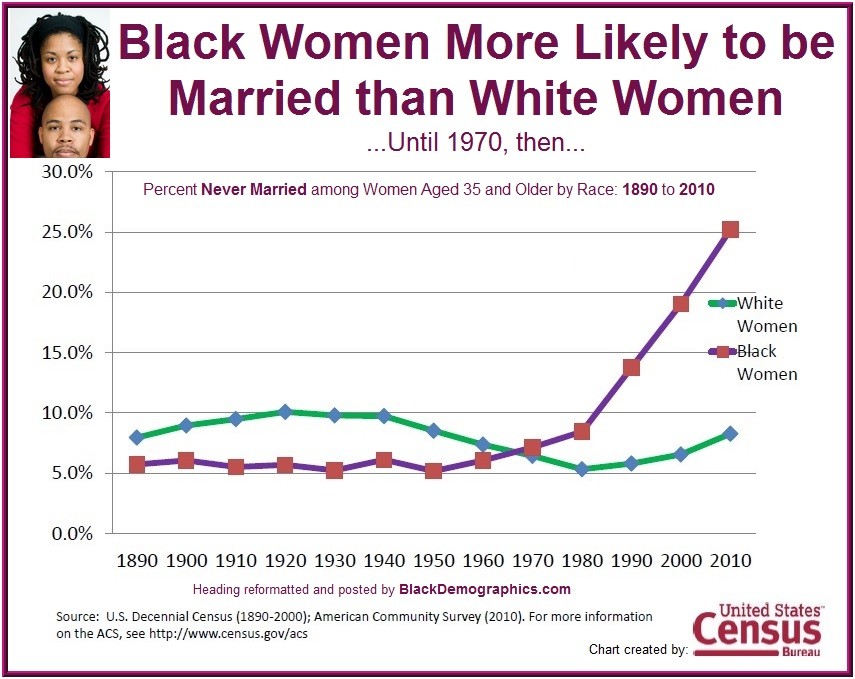
To separate fact from rhetoric, let’s begin with income. There clearly is a disparity.  According to a 2014 Census Bureau study, blacks are almost twice as likely to live in poverty as all races combined, 27% vs. 15.5%. What can explain this? Marriage. Conservatives have always argued the preeminence of family and the data (you know, “science”) proves it. 71% of all black children are raised by single mothers. The poverty rate for black married couples with children is only 10.8% but skyrockets to 46.1% for single mothers. The rate for all races is very similar: 8.2% poverty for married couples and 37% for single mothers with children. The drastic difference in poverty rates is almost wholly explained by family status.


Fig. 1 shows how black marriage rates were decimated soon after the war on poverty started.


Fig. 1


Family structure is not the only factor, of course. Figure 2 shows the impact of well-meaning but counterproductive government policy.


Figure 2


Poverty, war on, 1947-2012.jpgFigure 3 shows the inverse relationship between welfare spending and poverty reduction.


Poverty rate by welfare spending, inverse.jpg

Fig. 3


Despite ineffective anti-poverty policies, Figure 4 shows the poverty gap between black and white families continued to close until about 2000.


Poverty, black families 1967-2014.gif

Fig. 4


The education gap has also closed significantly. In 1940, the ratio of whites to blacks attaining college degrees was 5 to 1. In 2011, it was 1.5 to 1.


Black education rates 1940-2011.jpg

Fig. 5


Could simple geography partially explain the racial income gap? Possibly. While blacks are relatively well dispersed throughout the nation, there is still a major concentration in the South and other low income regions. If blacks had the geographical dispersion of Asians, the highest income group in America, the overall income gap might be smaller still.


America has come a long way but suspicion of white bias is not all fake, of course. A report on the Baltimore PD was just released showing lots of excessive force and harassment. While Part I showed that police abuse is not the problem it’s thought to be, should it surprise anyone if riots occur in cities where it is, in fact, worse? Also, there are a number of clever studies that show unconscious bias despite people’s good intentions. If you think you’re enlightened, take the Implicit Associations Test, then feel bad about yourself. However, blacks, too, have internalized this sense of inferiority. In 1995, one study had black participants answer 20 questions from the GRE. After being asked to simply state their race on the test, correct responses dropped in half.


Henry Kissinger argues that the notion of oppressed peoples rising up is a myth. The oppressed tend to rise up when the situation is improving. And that’s what seems to be happening here: It is finally safe to express anger at a level not seen even during the Civil Rights era. In Milwaukee right now, rioters are grabbing random whites off the street and beating them up. How interesting that now that we have a black president and the most equality-obsessed generation in history, the streets have exploded.


Some of this, of course, is due to a terribly cynical group of hucksters who exploit race hatred for political gain. They know that if blacks one day realize conservatives don’t hate them, the Democrat party is done. However, there has to be more to it. To confused, decent white people, the renewed anger doesn’t make sense. Racism is the biggest taboo in our culture and real progress has been made. Viewed through a psychological lens, however, it makes perfect sense. In the midst of danger, one simply survives. In the South, you will still find 80 year old black gentlemen who open doors for white people and call them “sir” and “ma’am”. We are only one generation removed from fire hoses and attack dogs and the collective PTSD is still working itself out. Will it? 


Unfortunately, many seem to be waiting for every vestige of unconscious racism to be vanquished before looking at the broken families and anti-intellectualism in their own communities. But unconscious bias doesn’t work that way. White women will continue to clutch their purses until the links between blacks and crime are severed by reality. That change has to come from within. If they are waiting for white people or a benevolent government to save them, it’s going to be a long wait.